Numbers you can print
Everything on this page comes from a published study with its data released, or from a dated measurement of our own store. Each figure carries its interval. Ask for anything else at hello@answerrange.com.
The findings
| Number | What it is |
|---|---|
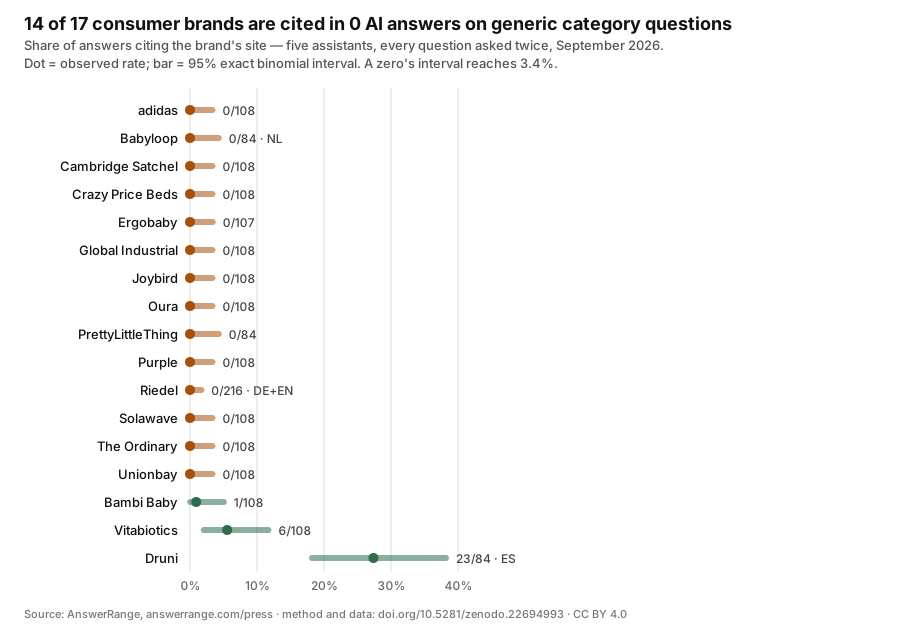
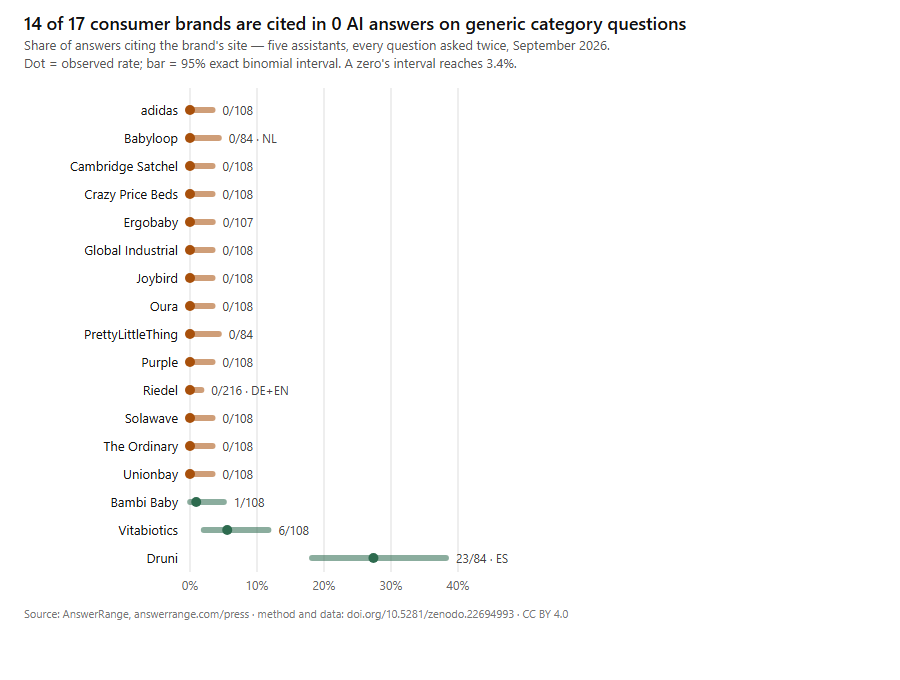
| 14 of 17 | well-known consumer brands scored 0 of 108 AI answers when measured on generic category questions — five assistants, every question asked twice (September 2026). adidas was one of them. The zero measures the question set, not the brand. |
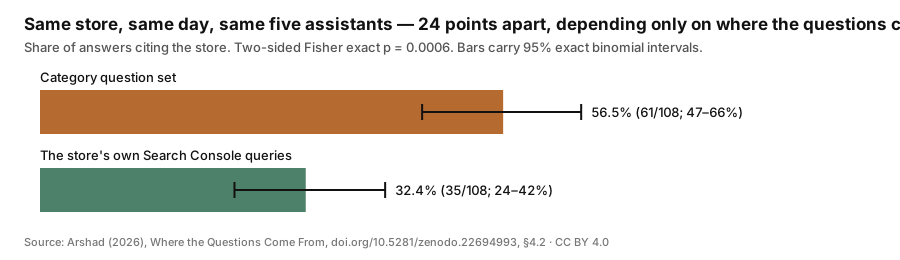
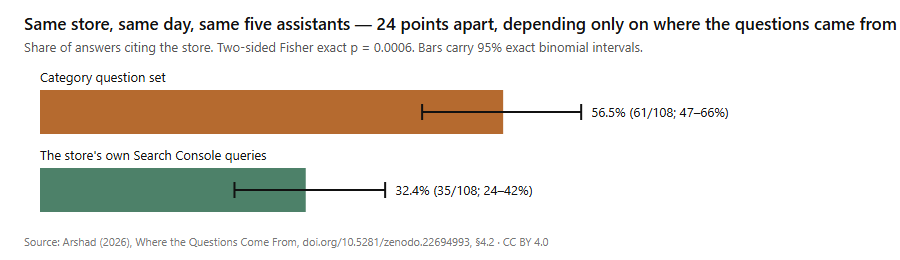
| 56.5% vs 32.4% | the same store, same day, same five platforms: cited in 61 of 108 answers on a category question set and 35 of 108 on its own Search Console queries (24.1 points; two-sided Fisher exact p = 0.0006). Nothing else varied. An earlier pair three days apart gave 59.5% vs 40.5%, p = 0.02. |
| 0–3% | the 95% interval on an observed 0 of 108. A zero has a narrower interval than any interior value, so the least informative measurement looks the most precise. |
| 16 of 16 | AI-visibility products coded from their own documentation: none states where its questions come from. (Vendors are not named, on principle.) |
| ±25 points | the interval on a claim built from 15 unrepeated prompts — every position in a ranking built that way is within noise of every other. |
| 5,400 | observations in the multilingual audit: five platforms, six languages, prompts authored natively rather than translated. The platform gap is large; the "language gap" is an artefact of translation. |
How a number is made — four lines
- Questions with a stated origin. Either the business's own search queries (Search Console, brand terms removed) or a category corpus built from real per-country search demand — and the report says which.
- Every question repeated on every platform, in each market's own language, written by a speaker of it.
- An exact interval on every number (Clopper–Pearson), reported alongside it, never behind it.
- A change is called a change only when a two-sided test says so, corrected across platforms; everything else is reported as within noise.
The studies
A fourth, pre-registered before-and-after intervention study reports in October 2026. Its analysis code and question set were fixed before the follow-up measurement; the result will be published whichever way it falls.
Quotable, as written
“A citation rate is never a property of a brand alone. It is a property of a brand and a question set, and most reports never say where the questions came from.”
— Muhammad Arshad, founder, AnswerRange
“The least informative measurement looks the most precise. A zero carries a narrower interval than any other number, and it is usually a question set that has nothing to do with the brand.”
— Muhammad Arshad, founder, AnswerRange
“Ask ChatGPT the same buying question twice and you get two different sets of sources more often than not. A visibility number built from one answer per question is a coin flip dressed as a percentage.”
— Muhammad Arshad, founder, AnswerRange
About
Muhammad Arshad is the founder of AnswerRange, a measurement service for how often AI assistants cite a business. He holds an MSc in Software Engineering of Distributed Systems from KTH Royal Institute of Technology, Stockholm, was a visiting researcher at the Open University's Knowledge Media Institute, and spent fifteen years building software and e-commerce across Sweden, Denmark, the UK and Pakistan — including a European store he built and ran from launch to €2.79M in sales, which is the subject of the intervention study. He is based in Islamabad. Google Scholar · ORCID · LinkedIn
AnswerRange (answerrange.com) measures how often ChatGPT, Google AI Overviews and AI Mode, Gemini and Perplexity cite a business, in each market's own language, on the questions the business is actually found for, with an interval on every number. A first measurement is free. Founded 2026.
Figures
Free to reproduce with the source line kept. Intervals on both are exact binomial on the counts printed.
Assets
Logo, square (PNG, 800×800) · Logo, banner (PNG, 1584×396) · Headshot on request.

What we will not say
We do not name the vendors whose methods we coded, we do not link a client's or a prospect's report, and we do not claim that any change to a page improves citation until the pre-registered study has reported. If a story needs one of those, we are the wrong source for it.